

Would you like to have your watchlist on all your devices? Log in or register for free.
Sailboat Hanse 410 for sale
Hanse 410 - on Yachtall.com
Your search: sailboat + manufacturer: Hanse + Hanse 410
 Create alert




Hanse 410
Sailboat / sailing yacht: Hanse, new boat - stockboat, GRP/polyesterLength x beam: 12.55 m x 4.29 m, 12.55 x 4.29 m built: 2025, cabins: 2
Engine: Yanmar, 56 hp (41 kW), diesel
€ 365,997
Location: Germany
2025
 Company: TPS centrum

The boat is completed at the shipyard and is offered with a 20% discount.


Hanse 410
Sailboat / sailing yacht: Hanse, used boat, GRP/polyesterLength x beam: 12.55 m x 4.29 m, 12.55 x 4.29 m built: 2024, cabins: 3
Engine: 57 hp (42 kW), diesel
€ 375,000
Location: Poland
2024
 Company: European Yacht Brokers


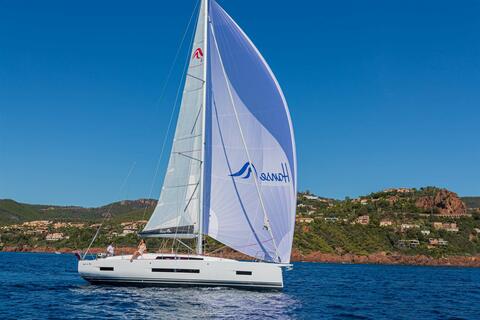


Hanse 410
Sailboat / sailing yacht: Hanse, new boat preordered, GRP/polyesterLength x beam: 12.55 m x 4.29 m, 12.55 x 4.29 m built: 2026
€ 299,000
Location: Germany, Laboe bei Kiel
2026
Company: Schiffswerft Laboe


The loft on the water: Hanse 410
In 2023, the Greifswald shipyard continued its modernisation programme with the new Berret-Racoupeau range, which had been launched in 2020. After the Hanse 460 had made a big splash and earned widespread respect within the industry and amongst sailors, the slightly smaller 410 followed hot on its heels. The clean, modern and flowing lines characteristic of the French design studio are carried forward: from the outside, the hull is recognisable by the pronounced chine edges at the stern and, above all, the negatively inward-curving stem with its beautifully integrated bowsprit. The windows embedded in the hull and the Hanse-typical windows in the cabin superstructure clearly identify it as a Hanse, but the design has been catapulted light years into the modern era when you compare the new 410 with its predecessor, the Hanse 415, which was still designed by Judel/Vrolijk.
All new: It’s not just the look
This almost radical move has shocked the industry, given that Judel/Vrolijk was regarded as the shipyard’s ‘in-house designer’. By switching to Olivier Racoupeau’s firm, however, Hanse achieves two things: It can immediately shed its somewhat ‘dated’ and, abroad, sometimes derided ‘German’ image. Berret-Racoupeau is a major, internationally active design firm specialising in cruising and sailing yachts. Even back then, the 460 showed where the journey would take the Greifswald-based company: wide, wider, widest – for greater comfort and more Mediterranean sailing. Die-hard Hanse fans, who love their boats primarily for their excellent upwind performance (important in the Baltic Sea!), may well regret this, as the new yachts follow the currently typical design paradigm of the extra-wide ‘iron-shaped’ hull, which is optimised primarily for half-wind and downwind courses – in other words, holiday sailing – whilst offering maximum volume below deck. Who would voluntarily sail closer to the wind than they have to?
But don’t worry: Racoupeau isn’t making the same mistake that Bavaria made back then with Cossutti. Whilst the changes to the Hanse are enormous, they aren’t too radical. The new ‘French’ Hanse is still recognisable as such. The fundamental design features have been respected and only slightly adapted. Racoupeau’s Hanse fits in beautifully alongside the shipyard’s classics and the Judel/Vrolijk predecessors. That is also why the shipyard has certainly managed to attract new customers – particularly non-German buyers. However, it’s not just about the exterior!
How sailing has changed – and how Hanse Yachts is responding
Recreational sailing has changed significantly in recent years. The boom in the charter industry has created a market for mass-production manufacturers, whose customers want one thing above all else: space! Charter yachts must be large, offer plenty of comfort and, above all, have spacious cabins below deck. On deck, they should be as easy to handle as possible (as usually only one of the charter guests has any real sailing experience), and should once again offer plenty of chill-out zones, lounging areas and sunbathing spots for the guests. And later, in port, they should be as quick and easy (read: cheap) to repair as possible. It’s important to bear in mind that mass-production shipyards supply up to 50 per cent of the vessels they build to charter fleet operators!
In private life, however, sailing has also undergone a fundamental change: the cruising sailor of yesteryear is now virtually a thing of the past. Skippers mostly use their yachts as day-sailers and weekenders – even the large boats – and spend only a few weeks a year on really long cruises. Here, too, the sailing itself is merely a secondary consideration: yachts are used more as floating holiday bases, as lofts and, increasingly, as on-board offices. This pattern of use also calls for comfort rather than sailing performance.
Hanse, like all other boatbuilders, has responded to this trend: very wide hulls, bright and airy saloons, spacious aft cabins and a modular design based on the motto ‘square, practical and good’. Both target groups stand to benefit: for whilst the prices are naturally high, production boats remain affordable compared with the classic, owner- and cruising-focused brands.
Buying a Hanse 410 – Hull, design, construction & sail plan
Modern boatbuilding is practised in Greifswald: the construction of the Hanse 410
Mass-produced boats are often somewhat disparagingly referred to as ‘yoghurt pots’. A label they really do not deserve! First of all: every sailing boat sold commercially must be inspected and assessed by an official certification body in accordance with CE directives. In the case of the Hanse 410, the CE category is Zone A, meaning unlimited ocean sailing in winds exceeding 8 Beaufort and waves over 4 metres. No skipper in their right mind would seriously sail a Hanse (or Beneteau, Jeanneau, etc.) into the storm-lashed regions of the Roaring Forties, but Category A is Category A. Consequently, the Hallberg-Rassy, Amel or Oyster is not ‘different’ or better – because they, too, are only Category A. What we’re trying to say is that a production yacht is perfectly capable of blue-water sailing, technically speaking. And, of course, the top brands are stiffer, more stable and better equipped for such deep-sea adventures – but the ‘yoghurt pots’ offer the same level of safety when it comes to weathering and surviving storms and bad weather!
As for the Hanse 410, the hull is constructed using the tried-and-tested outer-shell/inner-shell principle. In this process, a specially designed and moulded floor assembly is firmly and permanently bonded to the outer shell – which constitutes the entire hull and is visible from the outside. This assembly replicates the keel and frames. Once bonded, the hull is extremely stable and torsion-resistant in both the longitudinal and transverse directions. At Hanse, the load-bearing bulkheads are not made of wood, but are also high-strength composite components. Once these have been fitted and laminated in place, an almost monolithic hull is created, which is extremely stable.
The large hull sections of the Hanse 410, as well as the deck, are also manufactured using the modern vacuum infusion process, which saves on materials and weight whilst also providing significantly more comfortable working conditions for staff than would be the case with the ‘wet’ hand-lay-up method. So it’s strong, rigid and safe – no need to worry! And please, no more disparaging references to yoghurt pots.
The concept behind the Hanse 410: modern cruising, made in Germany
On the Hanse 410: With sailing yachts from 40 feet upwards, people usually start referring to them as ‘yachts’; boats in the classes below are simply … ‘boats’. This change in terminology therefore reflects, even in everyday speech, the slightly higher standard now expected of these vessels. Furthermore, yachts of 40 feet and above are large and stable enough to tackle major sailing ventures – such as Atlantic crossings and even round-the-world trips – seriously, safely and comfortably. Consequently, prospective buyers’ expectations of such a yacht are correspondingly higher.
As a two-cabin yacht in the ‘owner’s layout’, the Hanse 410 offers precisely this space, enormous storage capacity in the now-unoccupied second aft cabin, and, at the time of purchase, the option to operate the boat as a pure owner’s yacht with just one bathroom or with two bathrooms. As a three-cabin yacht, more guests and even larger families will find ample private space in the cabins. The yacht is perfectly equipped for cruising and holidays: well-balanced sailing performance (more on this later), a fantastic cockpit and plenty of comfort.
It is and always will be an agile sailing boat: the Hanse 410’s sail plan
Hanse is renowned for its excellent sailing performance and decidedly brisk sailing. We can reassure you that the switch to a French designer has done nothing to change that! Although the Hanse 410 is slightly heavier than, for example, the Oceanis 40.1 (9.8 tonnes compared to 8.2 tonnes), the Greifswald-based builders make up for this with a high-performance, tall rig.
Whilst you can fit the Hanse 410 with a furling mainsail (in-mast furling) and a self-tacking jib, which makes handling extremely straightforward, this leaves you with only 79 square metres of sail area. What’s more, these sails are rather difficult to trim; in particular, the battenless furling mainsail will contribute little to the boat’s propulsion when sailing on a bearing closer to a close-hauled course than a half-wind one. We assume that this configuration is more popular in the charter market. As an owner, it is therefore better to opt for the overlapping genoa at 43 square metres and the classic fully battened mainsail at 49 square metres. For one thing, you now have 82 square metres at your disposal, which may sound like only a slight increase, but in reality significantly improves the yacht’s performance. The efficiency of the sails is greatly enhanced, particularly thanks to their trimmability.
As the boat, when fully loaded, will easily exceed the 10-tonne mark, we strongly recommend equipping the Hanse 410 with a gennaker and Code 0 for use in areas with particularly light winds.
Cockpit highlight: This is where the Hanse 410 really shines!
We reckon the Hanse 410 has the best cockpit of any production yacht in this class! Above all, the fact that it is the only sailing yacht here to offer a split table (i.e. two tables) actually puts it in a class of its own, as two cockpit tables are usually only found on yachts of 45/46 feet and above. Why are we emphasising this so much? Firstly, the two tables ensure that the central aisle is always clear: the skipper or helmsman can move back and forth at any time between the helm stations and winches at the stern and the saloon/fore section of the yacht, without guests having to tuck their feet in or move out of the way. They can simply carry on chilling out in the sun, completely unfazed by the manoeuvre …
Secondly, the cockpit tables on the Hanse 410 can be lowered. As well as offering the option to extend the table surface by folding the table tops in or out, the tables adapt to suit the guests. And, of course, to the time of day: plenty of space in the morning, with everyone sitting at the table for a hearty breakfast; at midday, whilst sailing – the Lee table is lowered completely and, with the addition of extra cushions, becomes a large sun lounger, whilst the Lux table is folded away: Here you can sit, feel the breeze on your face and have a chat with the helmsman. In the evening, the tables are raised again: there’s room for everyone once more for a BBQ and a sundowner, but the drinks don’t take up the entire table surface. That’s luxury! And as I said: you won’t find this on any other 40-foot yacht from the major series manufacturers.
At the same time, Hanse supplies thick, superbly made cockpit cushions straight from the shipyard (something Bavaria also does brilliantly, whereas Beneteau and Jeanneau tend not to).
The market for 40-foot yachts is buzzing: Hanse’s competitors
Whilst we’re on the subject of the Hanse 410’s competitors, let’s take a closer look. After all, as a prospective buyer, you’re certainly spoilt for choice here too. Dufour has entered the fray with a strong contender in the form of the Dufour 41: also quite agile under sail and fitted with a single rudder, it offers slightly more volume but also has a more ‘bulky’ appearance. Up to four cabins can be fitted inside, though this is unlikely to be of much interest to private owners. The interior is very modern and a little extravagant – typical of Dufour, in fact.
The Bavaria C42 also has a very bulky and angular design, giving it plenty of volume. It is the widest of the 40-footers and offers the most space below deck. The quality of the joinery and woodwork is, as ever, of the highest standard; in this respect, no other mass-production shipyard can hold a candle to the Giebelstadt-based firm. The exterior design is divisive; in sailing terms, the C42 will tend to shine more downwind, but in our view it is class-leading in terms of space and luxury below deck.
With the Sun Odyssey 410, designed by Marc Lombard, Jeanneau is once again setting its own unique style: you have to like the ‘walkaround cockpit’, as it does take up quite a bit of space from the aft cabins below deck. As the Sun Odyssey is also the narrowest in the field at 3.99 metres, this is all the more significant. On the other hand, the Sun Odyssey is said to offer the best upwind performance and is therefore very well suited to sailing in challenging waters. Inside, we find it somewhat ‘cluttered’ and conservative – though this certainly has its fans.
Last but not least, industry leader Beneteau with the Oceanis 40.1. This yacht, also designed by Lombard, scores highly, particularly in terms of sailing performance. The design is modern, slightly more angular than that of the Hanse 410. Below deck, it is less versatile, but similarly understated and light and airy. As it is most similar to the Hanse 410, the purchase price could be the deciding factor here, as it is slightly lower for the French model than for the Hanse.
Buying a Hanse 410 – All the information for skippers and sailors
Top-notch sailing!
As a ‘proper sailor’, you’ll no doubt want to buy a yacht that performs well in all wind conditions. That’s a bit of a problem these days, as modern, extra-wide cruisers tend to be optimised for ‘holiday sailing’ on half-wind to downwind courses: it’s here, however, that modern hull designs really show what they’re made of. Particularly in calm seas and winds of around 15 to 18, 20 knots, the wide, flat hulls, working in tandem with the bilge lines, work their ‘magic’ – whilst heavy production cruisers like the Hanse 410 will almost never achieve a true planing speed, double-digit speeds are certainly possible. This also opens up new possibilities for cruising sailors, as downwind daily distances are now achievable that would never have been possible with the classic sailing boats of the past. This is because, due to their large wetted hull area (the so-called ‘lateral plan’) and their full-displacement design, these boats could never exceed their theoretical hull speed.
However, these high speeds come at a cost when sailing close to the wind. Dufour and Bavaria, in particular, feature very voluminous ‘big’ sections. Whilst these create palace-like owner’s cabins inside, they significantly reduce speed – and, above all, comfort – when sailing close to the wind. This is because these flat, bulky hulls have a tendency to plough into the waves when sailing close-hauled (so you have to bear away considerably and lose a noticeable amount of headway). Furthermore, modern, flat hulls can sometimes slap down very uncomfortably onto the waves when sailing close to the wind – to the point of potentially causing damage through mast pumping. The Hanse 410 is less affected by this, as Racoupeau has fitted it with a comparatively sharp and narrow bow – no doubt a specification from the shipyard, which thereby ensures upwind performance and seaworthiness even in rough seas.
Now, of course, the question arises as to how often one sails directly into the waves whilst on holiday – and these yachts are, after all, holiday boats. Voluntarily, rather rarely. However, in a sailing area like the Baltic Sea, the weather seems to change every six hours. Cross-seas (our ‘beloved’ Baltic chop) also occur. Anyone who sails here a lot is more likely to be looking for an all-round performer. That’s where the Hanse 410 really shines. On the other hand, anyone who uses their 40-foot yacht more as a day sailer to reach the nearest bay for anchoring, or who is a keen fair-weather sailor, is likely to prioritise having the most space on board. In that case, upwind performance takes second or even third place.
A bit cramped for the helmsman
Wherever space is created, space must be taken away somewhere else. For however large a yacht such as the Hanse 410 may be, the space available in the cockpit is still limited. Hanse has decided to maximise comfort in the guest area around the cockpit tables. Consequently, the two helm stations are, for our liking, positioned rather close to the helmsman’s seats aft – whilst standing, the skipper naturally has plenty of room here, but when seated, their knees do come quite close to the turning circle of the steering wheels. Anyone who enjoys steering manually and does so frequently will have to move back a little here.
However, we assume that most sailors are only actively involved in manoeuvring and rarely take the helm otherwise – the yacht is usually sailed by the ‘Autopilot’ crew member, so why ‘waste’ valuable space?
All lines aft: Easy sailing on the Hanse 410
We think the layout of this yacht’s running rigging is very well thought out: all lines are routed to the working winches aft (mostly below deck as well), so that the skipper can sail the boat entirely from here at the stern. You can even reach the handles (or buttons) on the working winches whilst standing behind the helm, so there’s no need to awkwardly step round to the front of the helm to re-trim the sails or operate the winches. That’s a definite plus. The gennaker or Code 0 is set using the ‘Genoa winches’, which on the Hanse 410 are mounted on the coaming roughly halfway along the cockpit. So, if you want to enjoy the breathtaking view and the impressive sailing performance of these large blisters in light winds, the guests on the leeward side will need to move slightly ‘out of the way’, as this is where the sheet is now on the winch. However, this is the only situation in which the guest area of the cockpit itself is ‘used’; as mentioned, under standard sail configuration, guests remain ‘undisturbed’.
Buy a Hanse 410 – comfort, below deck
Modern on the inside, a bit cool, but very versatile
Like all modern, very wide cruisers, the Hanse 410 boasts plenty of space below deck. The layout is classic and stylish, whilst the design is unpretentious and rather understated. The Bavaria C42, with its superior interior fit-out, and the Dufour 41, with its extravagance, are the standout models here. Those who prefer a more ‘no-frills’ approach will want to buy the Hanse, much like the Oceanis 40.1, which, however (though not in absolute terms, but certainly in terms of feel), seems a little ‘cramped’. This may be due primarily to its large longitudinal galley, which makes the boat more suitable for cruising but offers less seating and fewer relaxation areas.
The saloon table is striking; whilst it offers a vast amount of storage space, its simple ‘box-like’ design gives it a rather uninspiring and ‘basic’ appearance. Otherwise, the Hanse 410 scores highly in the saloon: two seating areas, a large dinette on the port side and a sofa on the starboard side, invite you to relax, eat and drink, and also for the skipper to work on the logbook or charts: The three-seater sofa can be shortened to a two-seater length on request, creating a small navigation corner for the captain at the rear of the bulkhead leading to the bathroom, facing away from the direction of travel. This is certainly practical if you intend to purchase the boat as an owner’s yacht for long trips.
Opposite the large day bathroom (with a separable shower area) is the galley of the Hanse 410. Here, the ship’s cook will first and foremost find plenty of space to spread out whilst cooking. The galley is equipped with all the necessary amenities; as is always the case with Hanse, the attractive Corian worktop is a highlight, which, depending on the colour chosen, can certainly dominate the space. The galley also offers an impressive amount of storage space, which should certainly rival that of the Oceanis 40.1’s galley.
3 or 2 cabins? The layouts of the Hanse 410
As previously mentioned, Hanse has decided not to launch the 410 as a multi-cabin model. This is because, as a 2- or 3-cabin model, the shipyard can keep production costs down by offering fewer options. As a private owner, this shouldn’t be a problem for you: the ‘owner’s version’ features two cabins and just one bathroom aft; here, you can order the sofa with or without the navigation corner for the skipper. The port-side cabin then serves as a huge storage compartment, which can be accessed from the cockpit or from inside via a small door in the sheet track leading through the galley.
What’s more, when you buy the boat as the owner, you can have your own bathroom fitted in the foredeck area: it’s excellent that Hanse fits both toilets on the port and starboard sides respectively. Other manufacturers don’t do it that way. Why is this important? When sailing close-hauled with a list, it is quite common – particularly on very wide boats – for the toilet on the windward side – being high up – to sometimes fail to draw in flush water because the intake is now above the water’s surface. The toilet then becomes unusable. Furthermore, a toilet on the leeward side – which is ‘lower down’ – is much more comfortable to use. A small but, from a nautical point of view, very important detail and a plus point in favour of buying the Hanse 410.
Air and light – always top-notch at Hanse
The Hanse 410 also scores highly thanks to its huge number of windows that can be opened. With a yacht of 40 feet or more, it’s certainly worth considering retrofitting air conditioning to cool the boat down efficiently in the height of summer. However, before making such a significant investment, Hanse’s fully opening windows in the cabin superstructure, together with the skylight hatch and the large companionway, ensure natural air circulation, draughts and, consequently, a pleasant coolness. No production yacht from any other manufacturer offers so much fresh air in the saloon.
Another pleasant feature is the abundance of natural light – further enhanced by the large hull windows. Guests in the aft cabins now benefit from this too, as the Hanse 410 is the first yacht of its size where even the rear cabins enjoy the beautiful views and natural light through the hull windows. At the front, in the owner’s cabin, however, there is one drawback: the hull windows are positioned so high up that, unfortunately, you cannot enjoy the view of the anchorage whilst lying down.
Beautiful wood, but simple furniture-making
In our view, the build quality of Hanse boats is of an average standard: the veneer is very attractive and sufficiently thick, but we find that solid wood components are lacking, particularly in areas that are frequently used or exposed. Corners and edges – particularly on the table tops, the steps leading down to the cabin or the floorboards – are fitted only with simple, glued-on edge banding. These can be easily damaged and wear out quite quickly. This is particularly true when moisture comes into play. Here, laminated moulded parts or solid square-edged timber would not only improve quality and durability but also enhance the impression of value. Bavaria and Dufour do this much better; Hanse is on a par with Jeanneau and Beneteau in this respect. There is room for improvement here. Otherwise, the design is rather simple and understated, though this is more than made up for by the outstanding quality of all the upholstery on board: in our opinion, Hanse offers the most comfortable upholstery, both in the saloon below deck and up in the cockpit.
Summary and conclusion
Is it worth buying the Hanse 410?
Are you looking to buy a stylish, modern and well-sailing yacht that can cover the same distance as it can serve as a swim platform for relaxing whilst at anchor? The Hanse 410 offers all this – and at a good price. As a ‘Made in Germany’ boat, it’s particularly appealing to sailors in the Baltic Sea, as its versatile sailing characteristics are spot on, and the cost of expensive lorry transport is saved by collecting it directly from Greifswald. Inside, it particularly impresses with plenty of light and fresh air, whilst the cockpit is the most luxurious in its class. Even if the build quality of the fittings doesn’t quite match that of the Primus, owners can look forward to a solidly built, thoroughly high-quality production yacht.
Buying a Hanse 410 – What we particularly like about it:
- A stunning, very modern design with a comparatively low freeboard.
- Best cockpit among 40-foot production yachts.
- Well-balanced sailing characteristics despite its extra width.
Buying a Hanse 410 – Here’s what you need to look out for:
- Simpler furniture-making quality.
- In strong winds, when sailing close-hauled, a single rudder requires a lot of steering effort.
- Somewhat heavy compared to others in the sector.
Further reviews and test reports:


