

Would you like to have your watchlist on all your devices? Log in or register for free.
Sailboat Hanse 510 for sale
Hanse 510 - on Yachtall.com
Your search: sailboat + manufacturer: Hanse + Hanse 510
 Create alert




Hanse 510
Sailboat / sailing yacht: Hanse, new boat preorderedLength x beam: 15.97 m x 4.91 m, 15.97 x 4.91 m built: 2026
€ 499,000
Location: Germany, Laboe bei Kiel
2026
 Company: Schiffswerft Laboe

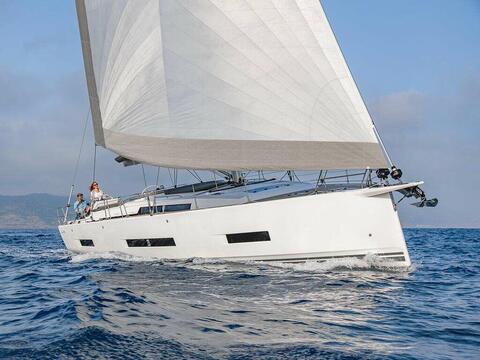


The ‘small’ big flagship: the Hanse 510
For most mass-market manufacturers, 50 feet is ‘home turf’. Why? Because, at last, both the designers and the buyers have enough space and financial leeway to avoid having to cut corners at every turn. In the truest sense of the word – because, with a yacht measuring 14 to 15 metres, the clientele also has much higher expectations regarding the boat’s luxury features and is prepared to spend the corresponding budget to meet them.
So let’s start straight away with the purchase prices: for one of the current 50-foot sailing yachts from the five major manufacturers, you should set aside a budget of between €550,000 and €750,000 (including VAT). Base prices can vary considerably in some cases, but once you’ve worked your way through the tempting and often lavishly equipped lists of options, you can expect to add a further 30 per cent of the base price for packages and options.
Given these substantial sums, you are quite rightly entitled to expect a significant boost in build quality, the range and standard of fittings, and overall comfort. Incidentally, this is exactly what the major fleet operators in the charter industry expect too, as 50-footers are, alongside 45-footers, the most popular boat size in the charter business. For this reason, all manufacturers also offer multi-cabin variants (4 to 5 cabins) with ‘streamlined’ specifications in terms of rigging and comfort, so that the lower prices demanded by this sector can be achieved.
The concept behind the Hanse 510: Mediterranean-style luxury meets German easy sailing
Following the Greifswald shipyard’s switch from its traditional ‘in-house designers’ at Judel/Vrolijk in 2019/2020 to the French firm Berret-Racoupeau, and catapulted itself into the upper echelons of series manufacturers with the Hanse 460, the shipyard is set to launch the second-largest yacht in its current range in 2024. The new direction taken by the French is clear: Mediterranean sailing is now also a priority for Hanse. This involves very wide hulls, optimised for half-wind and downwind sailing, which offer ample space – and therefore luxury – particularly below deck.
At the same time, however, they analysed in great detail what had happened just a few years earlier at Bavaria, their German yacht-building counterpart: they, too, had switched to a new designer, whose new yacht designs, however, represented a very sharp and extreme break from the style Bavaria had previously been known for. The C-Line, named after designer Maurizio Cossutti, bears almost no resemblance to the familiar visual attributes of the much-loved and tried-and-tested cruiser range. Many regular customers and Bavaria fans are turning away: the new, very angular and extremely modern yachts come across as too aggressive and too brutal. Although well-built and certainly good sailors, Bavaria has not been able to establish the C-Line with great success amongst new customer groups, because the brand image is and always will be … Bavaria. As an aside: it is certainly well worth taking a look at the Cossutti yachts too! But back to Hanse.
Olivier Racoupeau takes a different approach: his work is characterised by a lack of a drastic break with the past, as well as a great deal of respect for the brand and its established design language. He also creates ultra-modern, appealing designs which, however, retain many echoes of the previous models. He manages to instantly elevate his Hanse boats into a completely new, very modern generation of design, without, however, alienating Hanse fans and customers. The Hanse 510 is no exception: it fits in beautifully alongside its predecessors.
Nevertheless, despite all its design ingenuity, she is and remains a true Hanse – with all the features that sailors have always appreciated in this brand’s yachts. Even for such a large sailing yacht, Hanse offers a rig and winch setup that allows the boat to be sailed safely by a single person, thanks to the self-tacking jib and electric winches. A bow thruster and stern thruster should be standard features on a yacht of this size, because even though the Hanse 510 is still fitted with a single rudder, manoeuvring this colossus safely in harbour is a priority.
Modern design: Berret-Racoupeau designs a stylish, sleek sailing yacht
The Hanse 510 is a wide yacht: at 4.91 metres across against a hull length of 15.25 metres, it has a rather imposing presence, particularly when viewed from astern. This is also where one of the yacht’s major highlights is found: the dinghy garage. Nevertheless, Racoupeau manages to visually balance this ‘massiveness’ – which provides a great deal of space inside – in such a way that, on the contrary, the Hanse 510 is actually perceived as sleek.
Firstly, it features a comparatively low freeboard. Compared to the Bavaria C50, the Hanse 510 appears almost delicate in this respect. Added to this is a flat deck superstructure, which is elongated and tapers slightly aft before becoming flatter again towards the cockpit. When the Hanse 510 sails without a sprayhood or T-top, it looks very elegant. Its appearance becomes increasingly sporty thanks to the negatively inverted stem, which is the hallmark of the current Racoupeau yachts at Hanse. Admittedly, this comparatively heavy cruiser will never be able to utilise the ‘Wavepiercer’ bow design – borrowed from extremely fast high-performance racers – to its full sailing potential, but it certainly looks the part! The beautifully integrated bowsprit (essential for light-wind sailing) counterbalances the inward-curving line, whilst the very pronounced bilge edge in the foredeck and the elongated, narrow hull windows visually ‘extend’ the hull. Ultimately, the two waterline stickers typical of Hanse yachts – much like the racing stripes on cars – are the finishing touch to the Hanse 510’s visual appearance: brilliant!
The yacht looks much sleeker and more slender than it actually is; it has a very dynamic, almost slightly aggressive look. We’ve seen Hanse 510s with dark hull wraps whose presence almost rivalled that of a Solaris from the luxury segment.
The competition in the 50-foot sailing yacht class: the choice is yours
We’ve already hinted at this. The range of 50-foot sailing yachts on the market is very wide. The five major series manufacturers all have very different yachts in their product ranges, which differ not only in terms of absolute measurements (i.e. length, beam and volume) but also in character: from luxury swim platforms with a resort-like feel to cruising yachts designed for circumnavigating the globe.
It is important that you first familiarise yourself with the differences in metric measurements. This is because the ‘50-foot class’ is not a fixed category. The decisive factors here are the hull length and beam, as these two measurements (plus, in fact, the headroom inside) determine the usable interior volume. The ‘smallest’ yacht in this segment is the Sun Odyssey 490 from Jeanneau. As its name suggests, it is actually closer to the 49-foot class (although this ‘class’ does not officially exist). Measuring 14 x 4.50 metres, it nevertheless offers plenty of interior space, but does not have a dinghy garage.
Followed by the brand-new Oceanis 52 from industry leader Beneteau. Until now, one could always rely on Beneteau for excellent sailing performance and a beautiful, modern ambience – albeit with the simplest of interior fittings. Manufacturers such as Bavaria or Dufour, who offer very high-quality interior fittings, have always had a comfortable lead in this respect. That is now changing, as the Oceanis 52 (like the Oceanis 47) in the new eighth generation has significantly improved in terms of fit and finish. The Oceanis 52 doesn’t have a dinghy garage either, but it offers plenty, plenty of space (especially in the cockpit) and – of course – sails superbly.
The Hanse 510 and the new Oceanis 52 are almost identical in size, differing by just a few centimetres, which is interesting. Next comes the massive Bavaria C50, with a hull length of 15 metres and a beam of exactly 5 metres. ‘Impressive’ is the right word, because this yacht is the exact opposite of the Hanse 510 in every respect. It makes a grand impression in every dimension. No other yacht in the 50-metre class offers more interior volume, cabin space, bathroom space or saloon luxury. Anyone looking to buy a yacht that comes close to being a floating loft or holiday home will certainly have the C50 quite high up on their list. Whilst its sailing performance is more in the mid-range, this other German brand impresses with pure luxury and space. Well-crafted interiors and, depending on which specification you choose, an attractive price tag to boot.
Bringing up the rear (or leading the pack?) in the 50-foot class is the Dufour 54, which – with a hull length of just under 16 metres and an impressive beam of 5.25 metres – should really be classified in the class above. However, we’re letting it join in here with the 50-footers, as we feel this yacht comes closest in character to the Hanse 510. Whilst Umberto Felci’s lines are significantly more robust, the yacht’s sailing characteristics are certainly comparable. It is also fitted with a single rudder blade and has a large dinghy garage. Inside, the Dufour features an interior design by Luca Ardizio that is surprisingly extravagant and fresh in its details, giving it a more modern and extravagant feel than the Hanse. If you find the Hanse 510 a bit too ‘German’ or functional, the Dufour would be the ideal choice for a yacht that’s a little different.
Now you’ve got a choice when buying! Be sure to take a close look at the yachts at a boat show or out on the water during a trial week on a charter. Even though the final prices for fully configured 50-footers may often not differ all that much – their characters certainly do!
Buying a Hanse 510 – Hull, design, construction & sail plan
The Hanse 510 in production: robust and high-quality
Driven by high labour costs and, above all, ever-rising energy costs, mass-production manufacturers are seeking to make sensible savings, particularly when it comes to producing the large components of a yacht. Labour costs are a factor because a sailing boat – even in industrialised mass production – is still almost 100 per cent built entirely by hand. Particularly when laminating the hull and deck, many skilled workers are required to build up the structures layer by layer using the ‘hand-lay-up’ method. Energy costs, on the other hand, are a significant factor because the production halls used for hull and deck construction must be maintained within specific temperature and humidity ranges. These are sometimes huge halls that need to be heated in winter and, in summer, possibly cooled and dehumidified: and this must be done 365 days a year!
It is also possible to save on materials that are becoming increasingly expensive. The two basic components of a modern GRP sailing yacht are glass fibre mats and synthetic resins, such as polyester. Both are petroleum-based products.
One way of killing several birds with one stone – whilst also significantly improving working conditions for shipyard workers – is to use modern vacuum infusion and injection processes in the lamination stage. Manufacturers such as Bavaria and Dufour have almost completely switched to these methods, whilst the Beneteau Group has gone one better by using recyclable resins. At Hanse, mixed production is still the norm: some boats are hand-laminated, whilst others are produced using the vacuum process.
The Hanse 510 is also (still?) produced using a combination of methods. The large hull sections are hand-laminated, using a balsa wood sandwich core. The floor assembly and, it seems, the yacht’s large deck are apparently already produced using vacuum infusion.
Why is this important? As well as the financial savings, the yacht itself benefits too. This is because infusion/injection saves on material and therefore weight. You get stronger structures that are nevertheless thinner and weigh less. Less weight always leads to better sailing performance – particularly for holiday yachts, which are, after all, primarily intended to be sailed in fine weather (i.e. light winds and calm seas). And quite honestly: protecting the environment, conserving resources and providing a better working environment for those who manufacture the product are never a bad thing. However, vacuum infusion produces a great deal of plastic waste and can even be more expensive because better resins (vinyl ester instead of polyester) are used. So, as with everything, it’s a double-edged sword.
As simple and stress-free as possible, or full throttle? The sailing plan.
With the Hanse 510, skippers have a wide range of options when it comes to the yacht’s rigging. Traditionally, the shipyard fits rigs from the Swedish market leader Seldén, which we consider to be the industry’s best aluminium masts for production boats. As the owner, you can order the most basic configuration comprising a furling jib with a self-tacking system and an in-mast furling system. In this configuration, the Hanse 510 offers a total sail area of 119 square metres when sailing close to the wind. With this configuration, we recommend upgrading to decent cruising laminate sails – in particular, the furling mainsail should be fitted with vertical battens, as battenless, simple Dacron furling mainsails cannot be trimmed and are virtually ineffective when sailing close-hauled. Over time, inexpensive Dacron sails quickly lose their shape and, with it, their effectiveness.
If you want to make the most of the hull’s power and also take full advantage of the range of sail-trimming options for the jib and mainsail, opt for the overlapping genoa with a classic fully battened mainsail. With this configuration, you now have 126 square metres of sail area at your disposal – which, however, can be trimmed sensibly. A self-tacking jib has no clew adjustment and can only be set to the wind angle via a single sheet, which doesn’t work particularly well, especially on half-wind courses. The genoa can be adjusted at the clew points from the cockpit at any time and optimised precisely for every wind angle. Added to this is the Hanse 510’s backstay halyard – available only for classic masts – which allows you to adjust the sail’s bulge.
Not to mention the trimming options offered by the battened mainsail: it is the horizontal sail battens that make a wing-like profile possible in the first place, which provides propulsion. A furling mainsail can only dream of such a thing. So, if you’re an ambitious sailor or are planning a proper sailing trip with the Hanse 510 as a cruising yacht, this configuration is advisable. For areas with strong winds, you can, of course, have the self-tacking track fitted for the genoa and, if necessary, swap the genoa for the small jib. This allows you to retain the yacht’s versatility, for example on a round-the-world voyage. However, like all cruisers, the Hanse 510 has only one forestay, so you can only sail either the genoa or the jib.
A gennaker and a Code 0 are a must!
With a lightweight of just under 17 tonnes, the Hanse 510 certainly sits at the heavier end of the scale for our 50-footers. Only the larger Dufour 54, at 16.5 tonnes, has a similarly high displacement. The smallest of the lot – the Jeanneau, in fact – weighs just under 12 tonnes, the Oceanis 52 from Beneteau weighs 14.5 tonnes, and the massive Bavaria still has a lightweight of 15.5 tonnes. For all these yachts, a gennaker should form part of the minimum sail set on board.
Modern gennakers can now be operated fully automatically from the stern at the touch of a button as furling gennakers, although we would always recommend the less vulnerable alternatives with a recovery tube, which can be safely lowered at any time. The Hanse 510’s gennaker unfurls to an impressive 206 square metres and will propel the yacht confidently under light winds, long before you need to start the engines.
For wind angles sharper than 80 degrees, right up to sailing close-hauled, a Code 0 is recommended; on the 510, this has an area of 94 square metres.
Don’t underestimate light-wind sailing, as these sails are absolutely essential, particularly for yachts used purely for holidays in light summer breezes. Nobody wants to chug around their dream sailing grounds on diesel for hours on end. Modern gennakers and Code 0s are simple and safe to use (after all, there’s little wind and therefore hardly any waves). The colourful sails also make for an impressive sight and provide plenty of sailing fun.
XXL bathing platform and dinghy garage: massive plus points!
The highlight of the Hanse 510’s exterior is the huge swimming platform. Here, the shipyard has clearly taken inspiration from the motor yacht sector. On the Hanse 510, the swim platform isn’t just designed for jumping into the water and climbing back on board: it’s so huge that two adults can easily stretch out on towels to sunbathe.
The platform lowers to just above the water’s surface, making it very easy and safe to get into the water. If you’re sailing with children or elderly people, this is a definite safety bonus. What’s more, Hanse traditionally fits superb, very robust and sturdy stainless-steel components (throughout the boat, see handrails). No other yacht in the 50-foot segment offers such a well-made, rigid and luxurious ladder into the cockpit.
Behind it lies the dinghy garage. On the Hanse 510, this can accommodate a dinghy with a maximum length of 2.70 to 2.80 metres. The so-called ‘Smart Tender System’ on this yacht consists of a lifting arm which, like a small crane, swings the dinghy sideways into the garage or swings it back out again. The dinghy is therefore stored perpendicular to the direction of travel, which also saves space inside. Only the Dufour 54 (which is, however, larger than the Hanse) can even accommodate dinghies up to 3.10 metres in length.
The Bavaria C50, which is comparable in size to the Hanse 510, is similarly well-equipped when it comes to the dinghy garage. Here, the dinghy is hauled on board and launched in the traditional way, running lengthways over rollers. Beneteau and Jeanneau do not offer stern garages: their philosophy is that garages only pay off on boats of 55 feet or more, and so they prefer to use all the interior space for the cabins. The Oceanis 52 has telescopic davits at the stern, which allow for convenient dinghy transport. On the Jeanneau, the dinghy must either be dismantled and stowed in the lockers or (unsightly!) lashed down on the foredeck.
So it’s a clear victory here for the Hanse 510! The huge deck and the lovely spacious garage are unbeatable in this class.
A touch of luxury: the cockpit of the Hanse 510
Life on board a cruiser and holiday yacht centres on the cockpit. Hanse has clearly separated the area for the skipper and helmsman from the guest area within the spacious cockpit. All lines run concealed right up to the steering wheels, so that the entire yacht can be fully controlled and safely sailed from the rear. The layout of the instruments, the helmsman’s seating positions and the space available behind the wheels are generous – something that is often in short supply on smaller Hanse yachts. The winches are arranged in such a way that both the standard sails (halyards, reefing lines, sheets, stretchers) and the sheets for the light-wind sails on the secondary winches can be operated easily, without guests in the cockpit having to sit amidst a tangle of lines or constantly get to their feet.
As there are two cockpit tables, there’s even less need to get up, because you can easily step down between them into the interior of the yacht at any time. The tables can be adjusted individually and can even – when fully lowered – be transformed into huge sunbathing and lounging areas.
Although not exactly attractive, the rigid GRP bimini, used as a T-top, is an important option for anyone sailing in very sunny regions. The rigid T-top not only offers protection from harmful UV radiation, but could also accommodate a considerable number of solar panels on its roof.
Buying a Hanse 510 – All the information for skippers and sailors
Dynamic and agile: one of the most exciting 50-footers to sail
If you’re looking to buy a yacht that sails well, then the Hanse 510, alongside the Oceanis 52 and the Dufour 54, should be right at the top of your list. We’d consider all three to be the most interesting boats in this class from a sailing perspective. The Hanse also has a relatively ‘slim’ length-to-beam ratio and should therefore offer the best upwind performance of the three boats. However, even a Hanse has become extremely wide these days and is therefore designed more for reaching courses: Stalling close to the wind in choppy seas – and, above all, the unpleasant slamming into the waves accompanied by dangerous mast pumping – is also to be expected here once the wind speed and wave height reach a certain level. The only solution then is to bear away early.
Invest in good-quality sailcloth, as cheap, standard Dacron usually loses its water-repellent properties after just one or two seasons and loses its shape very quickly. You should definitely invest in vertical battens, particularly for a furling mainsail.
Single-rudder yachts: Dinosaurs or ‘sailing the old-fashioned way’?
Apart from Hanse, only Dufour still opts for single-rudder steering. All other manufacturers fit their very wide yachts with twin rudders, which are far more efficient when sailing. Like everything else on board a yacht, the choice of steering system has its own specific advantages and disadvantages. Single rudders are mechanically simpler, but must be designed to be much more robust – and therefore heavier – as the shear forces during steering are higher. However, they do at least provide some feedback from the water to the steering wheels and make manoeuvring easier under engine power, as the rudder blade is positioned in the propeller wash. Twin rudders are more complex and therefore require more maintenance. As they are not positioned behind the keel, they are also more susceptible to damage from floating debris. There tends to be little or no feedback at the helm. However, particularly at speed, the steering is more agile, quicker and requires considerably less effort (which conserves battery power when using the autopilot).
What type are you?
Buy a Hanse 510 – comfort below deck
A floating palace: inside the Hanse 510
As you would expect from a 50-foot yacht, the Hanse welcomes you below deck with an outstanding amount of space. The yacht’s beam extends from the shrouds right to the very stern, meaning that on board you will find large bathrooms and, above all, truly spacious aft cabins for guests. Hanse has always been synonymous with modern, clean-lined interior design that is not only stylish but also timeless. No frills, no excessive luxury, but rather luxurious understatement and a practical, seafaring approach.
We’re still torn between ‘ingenious’ and ‘brutish’ when it comes to the central piece of furniture that separates the dinette from the galley area. This piece is very thickly built and therefore takes up a large part of the space in the saloon. Other manufacturers achieve this in a much more delicate and elegant way. However, this is where the Skipper’s Place is hidden away: VHF, main control panel and auxiliary equipment. The captain operates all of this whilst standing, which speaks to the modernity of this yacht – albeit at the expense of a traditional navigation corner. Furthermore, this panel must always be open: It is no longer possible to take a quick glance at the panel to check whether the position lights are on or not. In addition to the vessel’s controls, there is also plenty of storage space concealed here. And on the opposite side, there is a comfortable bench seat for the 6th and 7th passengers to take their places at the dining table.
We like this piece of furniture, even though it takes up a lot of space, because it also provides a secure foothold for the ship’s cook whilst he’s busy in the large longitudinal galley. Alternatively, the galley could be shortened slightly and a nice chart table with a helm corner fitted in for the long-distance skipper. This would create a ‘utility room’ behind him, which in other layout variations could be converted into a bathroom or a Pullman cabin.
The Hanse 510 has a fairly classic layout, with the large day bathroom situated right next to the companionway on the port side. Unfortunately, even on the Hanse 510 in the owner’s version with 3 cabins and 2 bathrooms, the second bathroom is situated on the port side, which can lead to problems with the flush water supply when sailing with a starboard-to-bow list. It would have been wiser to position the toilets on both the starboard and port sides. That said, who sails for long periods against the wind with a severe list?
Otherwise, everything is very well built; the build quality of the Hanse 510 is as solid as you’d expect from a production yacht. Hanse uses stylish veneers and sets the standard, particularly when it comes to fittings and stainless steel components.
Five layouts – there’s something to suit every sailing programme
The Hanse 510 is available in a range of layouts. For a classic owner-couple looking to buy, the entry-level option features three cabins and two bathrooms. You can now opt for a third bathroom for the starboard aft cabin. In the standard version, you have the option of either choosing the day bathroom with a large, separate shower cubicle and access from the saloon – or opting for the bathroom without a separate shower, with exclusive en-suite access via the aft cabin only. In this case, the dinette in the saloon would also be enlarged.
The starboard bathroom, if chosen, is only available with en-suite access, which we think is excellent, as it greatly enhances the comfort factor: nobody wants to have to walk through the saloon in the middle of the night just to use the loo, but would much rather be able to go straight from the cabin into the bathroom. At the bow, in the owner’s cabin – which, incidentally, is a beautifully designed, spacious and light-filled room – the bathroom is fitted on the port side. It always features an additional shower. Up here at the bow, owners can choose between a large wardrobe for extra storage space or an ‘office’: a desk/dressing table situated directly to the right of the entrance. The standard layout features the wardrobe here, followed by a large armchair, which is ideal for getting dressed and undressed.
In the multi-cabin versions, which are more commonly used for charter, the Hanse 510 can accommodate up to five cabins. Instead of the huge sail locker in the foredeck, a sixth cabin for the skipper could then be fitted. So there’s a great, wide range of options to choose from when buying the Hanse 510 to suit your sailing plans!
Plenty of fresh air below deck: 18 hatches!
It is also worth mentioning the use of windows and hatches on board the Hanse 510. No fewer than 18 hatches can be opened on board, including all the side windows in the superstructure. This allows for a pleasant draught even on hot days, before the air conditioning needs to be switched on. The hull windows and, above all, the numerous skylights in the roof literally flood the saloon with light!
The aft cabins benefit most from this, as they are very light and airy. There is no plastic in sight; everything is clad in panelling or made of wood. The Hanse 510 thus boasts a very light and airy atmosphere – certainly a plus even on days when the weather is poor, as the days when yachts’ lower decks were quite rightly described as ‘dark mahogany caves’ are long gone. At least, if you’re sailing a 510.
Summary and conclusion
Is it worth buying the Hanse 510?
The Hanse 510 is a very modern, very stylish sailing yacht with innovative details. The raked stem and low freeboard create an attractive silhouette that complements the boat’s lively sailing performance. Spacious, modern and stylishly fitted out inside, this yacht really shines with its fantastic XXL swim platform and generously sized dinghy garage. Anyone looking to buy a large sailing yacht that combines luxury with well-balanced performance should take a closer look at the Hanse 510!
Buying a Hanse 510 – What we particularly like about it:
- A modern, dynamic and slightly aggressive design.
- Huge swimming platform and large dinghy garage.
- A wide range of layout options and plenty of flexibility for owners too.
Buying a Hanse 510 – Here’s what you need to look out for:
- A large yacht that really needs bow and stern thrusters.
- It needs sail area, especially in light winds.
- Although a central piece of furniture in the living room is practical, it does take up a lot of space.
Further reviews and test reports:


