

Would you like to have your watchlist on all your devices? Log in or register for free.
Sailboat Dufour 41 for sale
Dufour 41 - on Yachtall.com
Your search: sailboat + manufacturer: Dufour + Dufour 41
 Create alert




Dufour 412 Grand Large
Sailboat / cruising yacht: Dufour, used boat, GRP/polyesterLength x beam: 12.70 m x 4.20 m, 12.70 x 4.20 m built: 2016, cabins: 3
Engine: Volvo Penta 55 Hp Diesel, 55 hp (40 kW), diesel
€ 130,000
Location: Croatia, Zadar
2016
 Company: ALMISSANI


Dufour 41 GL
Sailboat / sailing yacht: Dufour, used boatLength x beam: 11.99 m x 4.30 m, 11.99 x 4.30 m built: 2025, cabins: 3
Engine: Yanmar, 60 hp (44 kW), diesel
€ 349,000
Location: France, Saint-Raphaël
2025
Company: BOATS DIFFUSION


Dufour 410
Sailboat / sloop: Dufour, used boatLength x beam: 12.35 m x 4.20 m, 12.35 x 4.20 m built: 2015, cabins: 3
Engine: 55 hp (40 kW), diesel
€ 159,000
Location: France
2015
Company: Band of Boats


Dufour 412 GL
Sailboat / sailing yacht: Dufour, used boatLength x beam: 12.35 m x 4.20 m, 12.35 x 4.20 m built: 2017, cabins: 3
Engine: Volvo Penta, 55 hp (40 kW), diesel
€ 120,000
Location: Croatia, Sibenik
2017
Company: NCP-Charter

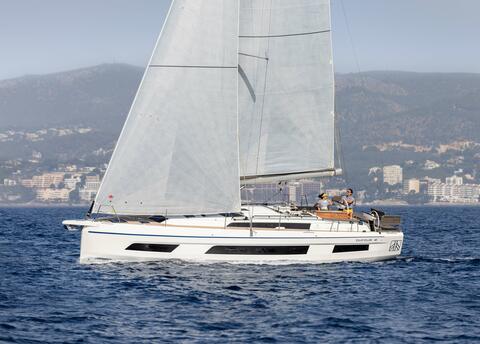


Dufour 412 Grand Large
Sailboat / sailing yacht: Dufour, used boat, GRP/polyesterLength x beam: 12.35 m x 4.20 m, 12.35 x 4.20 m built: 2017, cabins: 3
Engine: Volvo Penta, 55 hp (40 kW), diesel
€ 165,000
Location: Italy
2017
 Company: European Yacht Brokers


Dufour 412
Sailboat / sloop: Dufour, used boatLength x beam: 12.70 m x 4.20 m, 12.70 x 4.20 m built: 2019, cabins: 3
Engine: 50 hp (37 kW), diesel
€ 125,000
Location: Montenegro, Kotor
2019
Company: Band of Boats


Dufour 412
Sailboat / sloop: Dufour, used boatLength x beam: 12.70 m x 4.20 m, 12.70 x 4.20 m built: 2020, cabins: 3
Engine: 50 hp (37 kW), diesel
€ 149,000
Location: Montenegro, Kotor
2020
Company: Band of Boats


Dufour 412 Grand Large
Sailboat / sailing yacht: Dufour, used boat, GRP/polyesterLength x beam: 12.70 m x 4.20 m, 12.70 x 4.20 m built: 2019, cabins: 3
Engine: Volvo Penta 40 hp Diesel, 40 hp (29 kW), diesel
€ 170,000
Location: Croatia, Pula
2019
Company: ALMISSANI



Dufour 410 Grand Large
Sailboat / cruising yacht: Dufour, used boat, GRP/polyesterLength x beam: 12.33 m x 4.20 m, 12.33 x 4.20 m built: 2016, cabins: 3
Engine: Volvo Penta D2-55, 55 hp (40 kW), diesel
€ 190,000
Location: Italy, Lignano Sabbiadoro
2016
Company: Euro Sail Yacht Srl


Dufour 41 Classic
Sailboat / sloop: Dufour, used boatLength x beam: 11.89 m x 3.97 m, 11.89 x 3.97 m built: 1996, cabins: 3
Engine: Yanmar 3JH2-TCE, diesel
€ 49,900
Location: France, Martigues
1996
Company: Band of Boats


Dufour 410
Sailboat / sloop: Dufour, used boatLength x beam: 11.98 m x 4.20 m, 11.98 x 4.20 m built: 2015, cabins: 3
Engine: 55 hp (40 kW), diesel
€ 169,000
Location: France, La Seyne-sur-Mer
2015
Company: Band of Boats


Dufour 41 Classic
Sailboat / sloop: Dufour, used boat, GRP/polyesterLength x beam: 11.95 m x 3.98 m, 11.95 x 3.98 m built: 2002, cabins: 3
Engine: 50 hp (37 kW), diesel
€ 85,000
Location: Portugal, Lagos
2002
Company: Band of Boats

“The Dufour 41 feels bigger than it is …”
That, or something similar, is the verdict of many who step aboard the Dufour 41 for the first time. Designer Umberto Felci has created a hull based on the fundamental dimensions of 12.75 by 4.27 metres, within which interior designer Luca Ardizio has been able to give free rein to his creativity. The result is a boat with a strong emphasis on volume, whose widest point begins very close to the bow. This is what makes the saloon below deck seem so incredibly spacious: anyone looking for space – or a ‘dance floor’ – will love the Dufour 41!
The generous volume below deck not only creates a sense of space that no other mass-market competitor can offer in this way; the special hull shape also has an impact on the boat’s sailing characteristics. Although the Dufour is heavier than its competitors – which does not necessarily have a positive effect on sailing performance in light winds – it requires less ballast (only 27% in this case) and, thanks to its high shape stability and angular chines, displays very agile sailing behaviour – particularly on close-hauled to downwind courses – especially in fresh to moderate winds!
The concept behind the Dufour 41: a modern design concealing the spaciousness of a cruiser
The Dufour brand has always stood for ‘the slightly different’ French sailing yacht. Apart from the fact that Michel Dufour was the first, back in the 1960s, to successfully use the new material GRP in the mass production of boats at an affordable price through the inner-shell/outer-shell system, the shipyard in La Rochelle has always placed great emphasis on exceptional design. A Dufour is always a head-turner, whether on the water or at the jetty. For more than two decades, this has been ensured by the renowned yacht designer Umberto Felci, who not only brings Italian flair and a Mediterranean touch to the yachts’ shapes and appearance, but also continues to develop this style further. In the current series of Dufour yachts, the design is dominated by numerous large hull windows. These visually soften the bulkiness of the relatively high-sided hulls and give the yacht a dynamic appearance. The pronounced chines (keel edges) on a Dufour are not merely decorative. The current range is also characterised by a beautiful bow section, where an IMOCA-style inverted bow with a beautifully integrated bowsprit very elegantly and modernly conceals the considerable volume of this section: we think this is achieved more stylishly than on the similarly high-volume current Bavaria sailing yachts by Cossutti.
The central theme of the Dufour 41: space and light!
Umberto Felci and Luca Ardizio work hand in hand: you can see that straight away when you go below deck on the sailing boat. Whereas with other brands one sometimes notices ‘discrepancies’ and details that somehow don’t quite fit together, on the Dufour 41 it’s very clear that the hull department has worked very closely with the interior design team. The headroom on board is optimal throughout the yacht – even tall sailors and guests will feel comfortable on board.
Felci has designed the window openings in such a way that Ardizio can make the most of the abundant natural light precisely in those areas of the yacht where it is needed. As well as a light-filled seating and dinette area, the ship’s cook can also enjoy plenty of natural light in the longitudinal galley. More on this later. According to the shipyard, the Dufour 41 offers up to 60 per cent more light inside than many production yachts. This is certainly the impression one gets, which is mainly down to the numerous skylights and deck hatches – there are over 30 (!) hatches, portholes and windows fitted on board! A clever touch: some of the furniture surfaces are painted white, which reflects light even better than the wood veneer.
We find the lighting in the owner’s cabin in the bow particularly well done; here, Luca Ardizio makes excellent use of the generous headroom, and the hull windows are positioned nicely low down, so that you can enjoy a fantastic view of the anchorage whilst lying down. The design works: the Dufour 41 is arguably the brightest yacht in its class.
Buy a Dufour 41 – Hull, design, construction & sail plan
Rigid and robust: modern infusion techniques for the deck and hull
At Dufour, hulls and decks are not manufactured using the (significantly cheaper) hand-lay-up method, as is usually the case, but rather using vacuum infusion or injection moulding. There are two reasons for this: Firstly, the Dufour 41 is already heavy enough compared to its competitors, which is why this more complex process allows for significant savings in material and, consequently, weight. Secondly, these modern manufacturing techniques offer greater structural rigidity and resistance to osmosis. The vacuum process is also less prone to air bubble inclusions. This increases the production costs of the hull and deck compared with hand-lay-up competitors. Costs which, of course, must be offset elsewhere in order to remain competitive. But more on that later.
As the buyer of a Dufour 41, you can be confident that the yacht’s structure is modern and of high-quality construction, promising excellent rigidity, strength and durability. Of course, you should still treat the boat with a multi-layer, professional epoxy coating to protect against osmosis and apply a suitable antifouling coating to prevent natural fouling.
Dufour opts for single-rudder steering
Unlike most mass-production boat manufacturers, Umberto Felci and Dufour continue to focus on ‘single-rudder’ boats: only Hanse Yachts offers single-rudder yachts; all other manufacturers switched to twin-rudder boats a long time ago. As with everything to do with boats, this naturally has its pros and cons.
The advantage of a yacht with just a single central rudder blade is that the thrust from the propeller can be used precisely and easily to manoeuvre the boat. Even on a medium-sized yacht such as the Dufour 41, experienced sailors can often manage to dock and undock using just one rudder, meaning they can do without a bow thruster (although we would always recommend having one of these manoeuvring aids!)
Furthermore, the rudder mechanism fitted in the stern beneath the boat’s cockpit is much simpler in design: you only need one rudder tube, just one hull opening and fewer mechanical components to move the rudder. This means less maintenance, fewer potential faults and, of course, more space below deck.
However, the drawbacks cannot be ignored either: on older Dufour models, such as the Grand Large series from the 2010s – which remain very popular on the second-hand market and are frequently traded – Felci had to position the blade very far forward, towards the end of the keel. This is because, when the yacht heels, almost a third of the rudder blade protrudes from the water. This had a negative impact on the yacht’s manoeuvrability and responsiveness. This issue has been resolved in the new models, as the stern of the boats rises only moderately right up to the very stern, which is why the rudder can now be positioned very far aft.
Nevertheless, a single rudder blade must still be designed to be much longer than the blade on a twin-rudder vessel. This means that the forces exerted are also much greater than on twin-rudder vessels. Consequently, on the Dufour, both the rudder stock and the rudder shaft are designed to be considerably more robust.
Neither system is ‘better’: a single rudder provides more feedback to the helmsman, is easier to manoeuvre and requires less maintenance; twin rudders are more efficient when sailing on a heel and are much easier to design, but are more complex to set up and do not make manoeuvring any easier.
Dufour 41 for sale – sail plan and keel options
Like every Dufour in the current range, the Dufour 41 is generally available in three trim levels: ‘Easy Sailing’, ‘Ocean’ and ‘Performance’. Owners have the choice here between a version designed for ease of operation, featuring a furling mainsail and self-tacking jib, which ultimately means you can operate the boat entirely with just two winches. The ‘Ocean’ and ‘Performance’ versions, meanwhile, feature a classic, fully-battened mast with significantly more sail area and the full range of trimming options one would expect on a cruiser.
This allows you to increase the Dufour 41’s standard sail area to up to 83.5 square metres. Fitting the yacht – which has a displacement of just under 10 tonnes – with efficient light-wind sails is particularly important. Given that the Dufour 41 is heavier than all its competitors (the Beneteau Oceanis 40.1 and Jeanneau Sun Odyssey 410 weigh 8 tonnes, the Hanse 410 at 9.6 tonnes and the Bavaria C42 at 9.7 tonnes), you should definitely purchase a suitable A3 gennaker and a Code 0 for this yacht if you’re planning a sailing holiday.
The keel of the Dufour 41 is particularly worth highlighting: here, too, no ‘cost-cutting’ has taken place, as price-conscious mass-production manufacturers usually do without the expensive lead and offer only cast-iron keels. With Dufour, the optimised keel is always fitted with a lead bulb, which reduces the draught compared to a similar cast-iron keel. A standard option with a draught of 2.10 m and a short-keel variant with a draught of 1.75 m are available. With the short-keel variant, the Dufour 41 could even be sailed in large inland waters, such as Lake Constance, provided you can find a mooring.
 “The Dufour 41 is particularly well suited to sailors in areas with moderate to strong winds: the yacht needs a bit of wind, but is then perfect for your sailing holiday.”
Buy a Dufour 41 – All the information for skippers and sailors
The joy of sailing – a holiday for the whole family
The image of Dufour yachts has changed considerably over the last 15 to 20 years. Some owners will still remember the sleek ‘E’ variants of the Dufours from the late 1990s to the early 2000s. Back then, Dufour was synonymous with cruising performance. Today, things are completely different. Whilst Dufour 36 E models and other variants are still available and popular as second-hand boats, the new boats – starting with the ‘Grand Large’ series at the latest – are consistently designed with holidays and cruising in mind.
Large swimming platforms, the plancha grill at the stern, spacious cockpits and, most notably, the massive increase in volume are the hallmarks of modern Dufours. This is most evident when viewing the boats from above: The Dufour 41 is shaped more like an iron than a yacht. Modern designs make this possible: the role traditionally played by weight stability is now taken over by the boat’s beam and chine (also known as ‘shape stability’), and this creates a huge amount of space inside.
The price: The upwind performance of modern production cruisers is generally inferior to that of their classic predecessors. Whilst attempts are made to compensate for this somewhat through slender bows and a more or less subtle V-shape in the underwater section, modern cruisers are nevertheless rather uncomfortable when sailing close to the wind: The familiar ‘slamming’ and mast pumping mean you have to bear away early, particularly in choppy seas. Anyone who wants or needs to sail close to the wind should tend to avoid such yachts.
So why do manufacturers do it anyway? Because these yachts – used primarily as family or charter boats for holidays – are mainly sailed on pleasant ‘holiday routes’ from half-wind to downwind. And here, wide hulls are actually an advantage: Felci deliberately incorporates hull features from Class 40 or IMOCA racing yachts into the Dufour 41. So holidays are the main focus here.
Popular with charter guests and boat owners
And the Dufour 41 is also extremely popular amongst this customer group: an exceptionally high proportion of the boats produced by the shipyard go straight into the charter market. These companies appreciate the outstanding space on board (particularly in the 4-cabin version) and the yacht’s ease of maintenance and handling. After all, in the charter business, short turnaround times are key, which is why ‘square – practical – good’ is always preferred over the more complex (but more attractive) yachts when it comes to furnishings and maintenance/replacement.
This is an aspect from which you, as a private owner and sailor, can certainly benefit: through Dufour specialist dealers, you too can obtain any damaged or broken parts quickly and affordably, and often even replace them yourself. Which brings us to the subject of ‘price’: here too, Dufour plays something of a pioneering role.
Great value for money: the Dufour 41 could well prove to be a bargain
In recent years, Dufour – much like Hanse Yachts – has stood out for its very aggressive pricing policy. This enabled the shipyard in La Rochelle to significantly expand its share of the overall market, particularly in the mid-to-late 2010s; in Germany, in particular, Dufour was ‘all the rage’. Even following the sale of the shipyard and the takeover of the catamaran manufacturer Fountaine-Pajot, the shipyard’s price-aggressive approach remains in place: although the ‘smallest’ Dufour 41 currently costs just over €240,000 net in its base price – roughly the same as what you’d pay for competing vessels – the shipyard regularly offers interesting promotions and value-for-money packages. It is therefore well worth negotiating with the dealer when buying a new boat and, above all, making the most of major boat shows such as Boot Düsseldorf or the Cannes Yachting Festival to snap up a bargain.
But beware: as with all ‘special offers’ or ‘permanent low-price deals’, the money has to be saved somewhere else. Since the manufacture of the hull (vacuum process), keel (with lead ballast) and other parts tends to be of a higher quality than the competition’s, this must be offset somewhere else. Some owners and dealers report quality issues ‘behind the panelling’ or compromises in the boats’ finish quality. It is worth taking a close look with a professional (especially with second-hand boats). On the other hand, as every yacht is almost 100 per cent handcrafted, such shortcomings are by no means limited to Dufour, but can be found among all mass-production manufacturers.
Buy a Dufour 41 – comfort below deck
Attractive layouts for owners, families and charter crews
We’ve already mentioned the stylish layout with its abundance of natural light: the Dufour 41 really shines below deck! We believe this yacht offers the most modern layout of any major series manufacturer, and certainly the one with the most natural light. In the ‘owner’s version’ with three cabins, the yacht comes with two toilets/bathrooms: we particularly like the fact that the toilets are fitted on both the starboard and port sides. On yachts as wide as the Dufour 41, when heeling, the intake for the toilet flush water can sometimes end up above the waterline, rendering the toilet on the ‘high side’ unusable. In such cases, the leeward toilet is often the better option: it has a water supply and is also more comfortable to use when the yacht is heeling.
The aft cabins are the same size on the 2-, 3- and 4-cabin models. If you sail frequently with guests or family, you may wish to provide a bathroom/WC in each cabin. In this case, the large shower on the starboard side – which is on the port side in the owner’s version – is converted into a shower-WC. The only drawback of the guest WCs is that neither is an ‘en-suite’ walk-in facility, so you always have to go through the saloon first when you need to use the toilet. At the bow, the owner’s bathroom is particularly appealing as it is situated on the port side. This means the entrance to the owner’s cabin is asymmetrically offset to starboard, so that there is no unobstructed view of the owner’s bed from the saloon. The shower here at the bow could be slightly better separated from the toilet area, but ultimately, space on board the Dufour 41 is limited.
On the 4-cabin model – which is likely to be used almost exclusively for charter operations – the bow area is symmetrically partitioned off by a longitudinal bulkhead, creating two cabins with (relatively narrow) double berths at the front. You then sleep with your head towards the door, as it would be very cramped if you were to sleep facing the forward bulkhead. There is no longer a bathroom at the bow: all guests share the two aft toilets. As the deck moulding must already incorporate the slots for the bulkheads and walls of the charter version, these are naturally also visible in the ‘owner’s version’. Dufour has omitted ceiling panels in the foredeck – which is rather an eyesore. This is, in our view, the only drawback of the interior design.
Dufour 41 for sale – Natural light and light-coloured woods
We have already mentioned the more than 30 openings in the ceiling and hull, which allow plenty of light and fresh air into the yacht. This is further enhanced by the options available in the options list regarding fabric and colour choices for the interior design. Even with darker colours, the Dufour 41 remains a very bright and welcoming yacht. One detail we find particularly well executed is the saloon floor: here, Luca Ardizio has taken great care to ensure that the individual floorboards are almost identical in size. As a result, the gaps appear very symmetrical and are not as distracting as on other yachts.
In particular, the quilted bulkhead leading to the owner’s area, which is entirely white, blends beautifully with the elegantly crafted companionway steps and the white-painted compartments of the saloon storage. A modern, very stylish interior that nevertheless manages without any frills – well done!
The ship’s galley – a real bone of contention – you’ve got to love it!
The galley isn’t quite as well designed, at least according to some potential buyers of the Dufour 41. The main focus here is on the large, central fridge unit, which consists of a front-loading fridge and a top-loading fridge behind it. This means the Dufour 41 offers an exceptionally large amount of refrigeration capacity even as a standard model – remember: the main aim here is to enjoy a lovely holiday, so you can never have too much refrigeration space!
However, as even the spacious saloon of the Dufour 41 is limited in size, and space had to be found for a sink, a worktop and a hob alongside the fridges, a clever solution was needed. Ardizio has therefore positioned the fridge units one behind the other. This literally ‘divides’ the longitudinal galley in two, forcing the ship’s cook to constantly walk round the fridges. On the other hand, this means that two people working here don’t always get in each other’s way …
Whether this layout is important to you as a prospective buyer, and whether you find it more of a hindrance or acceptable, is best discovered during a live tour of the yacht, as even the best online VR representation cannot replace the full, authentic sense of space. We would also recommend chartering the Dufour 41 for a week or two before buying – as it’s only by spending several days on board that both guests and sailors can assess whether it suits their sailing plans and itineraries.
The cockpit is huge – and a bit cramped
That might sound a bit odd at first – after all, how can something be cramped if it’s large? In fact, the Dufour 41 actually offers slightly more usable cockpit space than its competitors. The bench seats are very wide, and the cockpit table, which tapers towards the front, easily accommodates a full evening meal when extended. However, on the classic rig variant with a battened mainsail, the working winches are still positioned next to the companionway, which means that when trimming the sails, you have to keep walking right across the entire cockpit, and many of the line ends are left lying around in the cockpit (or at the bottom of the companionway). Only the genoa sheets are at the stern.
And this is where things get a bit cramped – for the helmsman, that is. Because Dufour has designed the benches to be so long and has fitted helmsman’s seats as well as the plancha grill across the full width of the stern, legroom behind the steering wheels (which are, moreover, a little too small for a boat of this size) is rather limited. Perhaps the assumption is that you’ll rarely be actively sailing here and will mostly leave the cruising to the autopilot – skippers with very long legs or a larger build should bear this detail in mind.
Summary and conclusion
Could the Dufour 41 be your next yacht?
We are particularly impressed by the interior design, with its abundance of light and its stylish, uncluttered look. The Dufour 41 is a beautiful, modern sailing yacht designed for maximum volume. As it requires a little more wind to fully utilise the power of the Felci hull, the boat is best suited to sailing in areas with moderate to strong winds. Incidentally, in our view, this characteristic also makes the Dufour 41 particularly well-suited to offshore use (think: Atlantic crossings) or strong-wind areas such as Greece. Anyone wishing to sail in areas with very light winds should have high-performance gennakers or Code 0s on board and should definitely opt for the rig configurations offering maximum sail area (i.e. not the furling mainsail).
… or would you rather buy a second-hand Dufour?
This is a question many boat buyers ask themselves. Even a shipyard offering competitive prices can quickly reach prices in excess of € 300,000 for a brand-new Dufour 41. Dufour yachts are also frequently found on the second-hand boat market. If the boats have previously been used for charter, be sure to check the number of cabins and the type of rig fitted. As the somewhat ‘leisurely’ Dufour 41 is likely to be motored more often, when considering a second-hand model, you should pay particular attention to the engine hours and the associated wear and tear on the engine, gearbox, saildrive and all related components. If sailing performance is your main priority, it’s worth taking a look at the (slightly narrower) predecessor models of the current range.
Buy a Dufour 41 – What we particularly like about it:
- A really stylish interior with plenty of natural light.
- Innovative hull design for maximum interior volume.
- Quite good sailing performance with a performance rig.
Buying a Dufour 41 – Here’s what you need to look out for:
- Rather mediocre performance in light winds.
- There may be a flaw in the finish.
- The helmsman’s position is a bit cramped, and the kitchen is ‘split’ by the fridge.
Further reviews and test reports: