


Would you like to have your watchlist on all your devices? Log in or register for free.
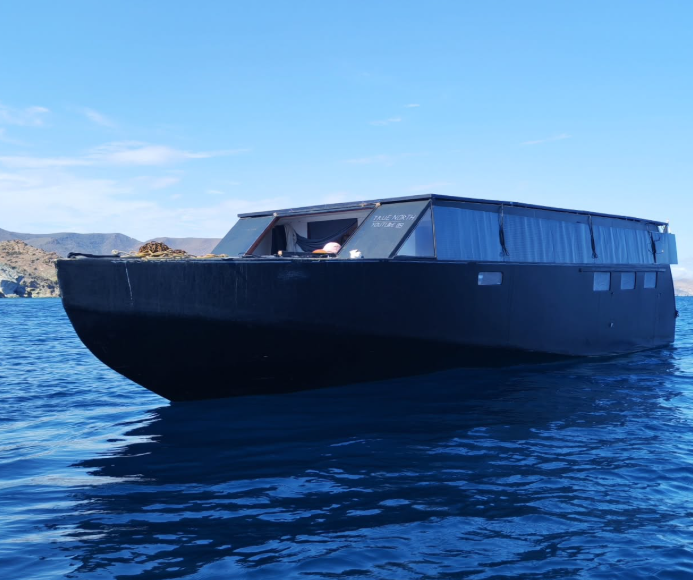
Helios 11: A homemade boat that travels with the sun

In a Finnish shed, Lukas Sjöman built an eleven-metre-long boat that generates its own electrical power. The Helios 11 combines a lightweight plywood hull, large-area solar panels and an electric propulsion system. On his journey to Ibiza, the Finn put this unusual concept to the test.
Lukas Sjöman invested around 200 working days in a project in which the designer, boatbuilder and eventual skipper were largely one and the same person. Far from any professional shipyard, the Helios 11 was built in Finland: a habitable solar-powered boat designed for long-distance voyages. Sjöman then sailed his self-built boat across European waters all the way to Ibiza. Media reports put the distance covered at around 5,700 kilometres – travelled without conventional fuel.
The technical concept is already evident from the silhouette. An elongated, flat hull keeps the wind resistance low, whilst large solar panels dominate the appearance. The dark colour scheme gives the boat a striking look. However, it is the function that is crucial: the Helios 11 is designed to travel on as little energy as possible whilst generating sufficient electricity for life on board.

Weight plays a key role in this. The hull, approximately eleven metres long, was constructed from marine-grade plywood and fibreglass. The boat’s weight is stated as around 1.5 tonnes. For a habitable vessel of this length, that is a remarkably low figure. The lightweight construction supports Sjöman’s aim of keeping the power required for propulsion to a minimum. It is this efficiency that makes the available solar energy a viable basis for longer voyages.
Power is supplied by standard photovoltaic modules, of the kind also used on buildings. They are located on the roof and on the side panels. The energy they generate is stored in batteries and used to power the electric drive system and the on-board electrical system. The solar system, energy storage and motor thus form a single integrated system, the performance of which determines the day-to-day reality of the journey.
The motor power is stated as six kilowatts. Less clear are the published figures for the solar system and battery capacity: these vary between reports, whilst Sjöman continues to modify his prototype. A documented voyage of 55 nautical miles provides a vivid impression of how the system operates in practice. During this journey, the Helios 11 travelled at approximately six knots and reached its destination with 65 per cent of its battery charge remaining. Converted, this equates to around 102 kilometres at a speed of roughly eleven kilometres per hour.

Hidden beneath the solar panels is a simple living space. Sleeping accommodation, an electric hob, a fridge and a flush toilet make up the essential fittings. According to Sjöman’s own assessment, the Helios 11 in its current state is particularly suitable for one or two people. He states that it even offers sleeping space for up to five people. This layout therefore allows for longer stays on the water without compromising the boat’s fundamental principle of economy.
However, how well the system works depends on the conditions encountered whilst underway. Cloud cover and the position of the sun affect power generation; wind and waves alter energy requirements. In addition, the boat is fitted with a small auxiliary sail. Sjöman realised that careful planning remains essential during a night-time leg of the journey: by his own account, he only reached the anchorage with the battery practically flat. The trip highlighted just how important energy reserves are in a concept of this kind.

Day-to-day life on board also provides insights for further improvements. Sjöman reports heat and occasional dampness inside the cabin. There is no air conditioning. Added to this are nights when the lightweight boat rolls at anchor, making for a correspondingly restless night’s sleep. The Helios 11 is therefore both a cruising boat and a floating test bed, on which its strengths and weaknesses can be experienced first-hand.
Sjöman quotes a cost of around 30,000 euros for its actual construction. The figure of 18,000 euros, which is also frequently cited, is based on a different calculation: this amount stems from his retrospective estimate for a better-planned overall system in 2026. Anyone wishing to assess the cost-effectiveness of building the boat themselves must distinguish between the actual expenditure on the prototype and the calculated cost of an optimised replica.

The Helios 11 demonstrates how closely form, weight, propulsion and equipment are interlinked in a solar-powered boat. Every reduction in load and every instance of avoided energy consumption helps the boat to travel further on the electricity it generates itself. Lukas Sjöman has translated this concept into a habitable boat – and tested his design over thousands of kilometres. The journey thus provides practical experience for a way of boating in which the available energy helps determine both the design and the course.
Text: Christian Klumpp / medienmacher.eu
Images: Lukas Sjöman (Instagram, private)


