






Would you like to have your watchlist on all your devices? Log in or register for free.
Three natural spectacles that delight yachtsmen

Anyone travelling by yacht experiences the sea as more than just a route between two harbours. A night watch under the stars, an unexpected dorsal fin alongside the boat or water that suddenly glows can turn a perfectly ordinary sailing trip into a moment you won’t forget for years to come. In our new series, we’ll therefore be taking a regular look at what’s happening on the world’s oceans right now, and at the insights that make such encounters even more exciting for sailors and yacht enthusiasts.
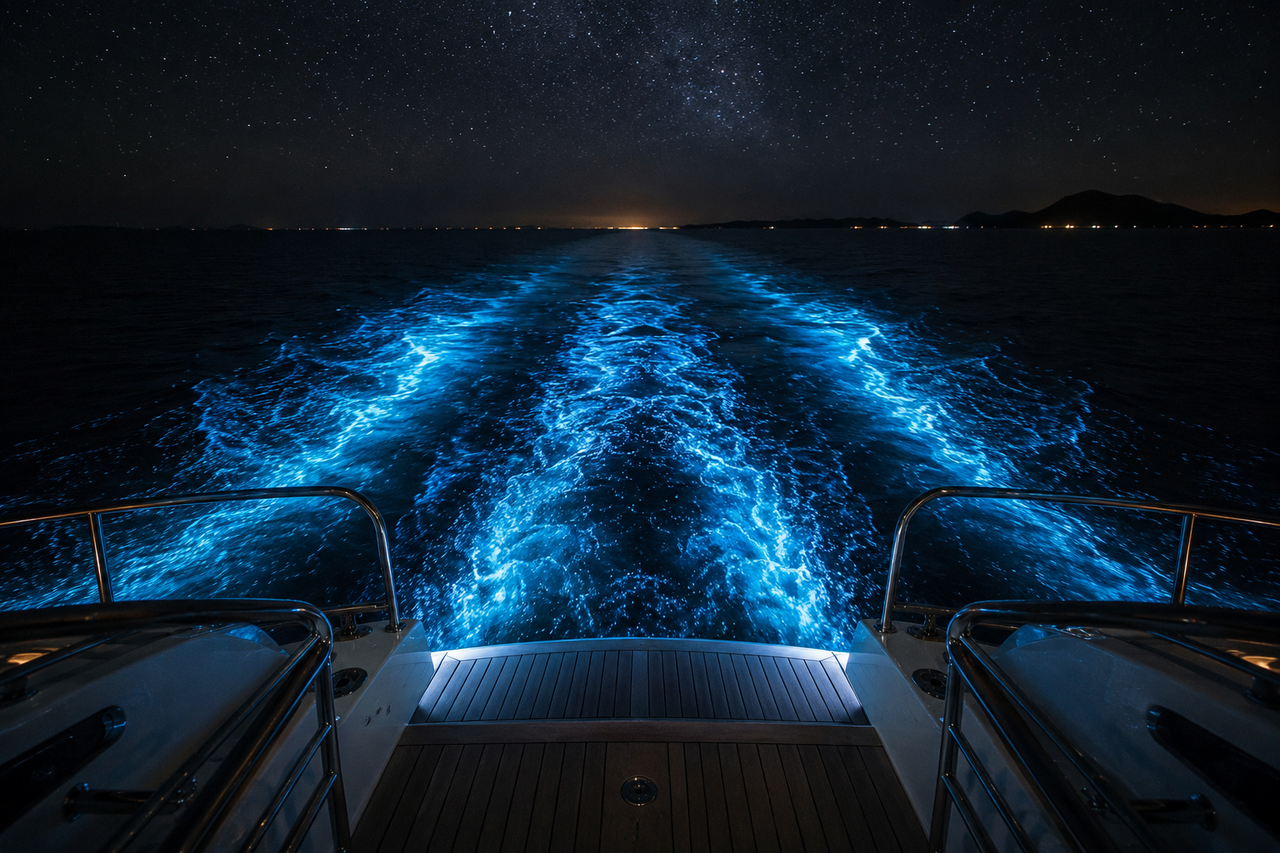
When the wake suddenly glows blue
A particularly fascinating phenomenon was observed around Brisbane in early August: in places, the sea glowed an intense blue at night. This bioluminescence is caused, amongst other things, by tiny marine organisms such as Noctiluca scintillans, which produce light when they move. For yacht crews, this can create an extraordinary spectacle, as the bow wave, wake or a trail left by a dinghy as it cuts through the water suddenly begins to sparkle. Anyone out at sea at night should therefore occasionally look not only at their instruments and the horizon, but also at their own wake. Bioluminescence is one of those natural phenomena that look impressive in photographs, but have a completely different effect when experienced on board.
Unforgettable encounters with whales at sea
Off the Brazilian coast, numerous humpback whales are currently on their annual migration once again. For sailors, such an encounter is a striking example of why a good lookout at sea serves more than just safety purposes. Often, a whale first announces its presence on the horizon simply by its blow, before its back, tail or – with a bit of luck – even a leaping animal comes into view. Those who know what to look out for often spot such encounters earlier and can enjoy them from a safe distance. The science behind the spectacle is also fascinating: Many whale species travel thousands of nautical miles each year between their feeding and breeding grounds. These distances are impressive even for experienced offshore sailors. A whale sighting thus becomes not just a photo opportunity, but an encounter with one of the ocean’s great travellers.
Beneath the keel lies a world that hardly anyone knows
Whilst we on board keep an eye on the wind, waves and water depth, beneath a yacht there is often a landscape of which nothing can be seen from the surface. A recent deep-sea expedition off Trinidad and Tobago discovered more than 25 active cold seeps, as well as animals that may represent species as yet completely unknown. These included unusual octopuses, carnivorous sponges, ghost sharks and so-called zombie worms.
Such cold seeps form entire ecosystems on the dark seabed, where life is sustained not by sunlight but by chemical energy. For yachtsmen, the appeal of such discoveries also lies in a simple realisation: beneath many areas that we perceive on nautical charts as depth figures or coloured patches lie mountains, gorges, springs and habitats that have scarcely been explored. Looking at the echo sounder takes on a whole new meaning when you realise that several hundred or thousand metres below the surface there may lie landscapes that no human has ever seen with their own eyes.