


Would you like to have your watchlist on all your devices? Log in or register for free.
The Newest Discipline in Superyacht Building: Luxury Hospitality Architecture

In the world of superyacht building, every era has brought a new layer of sophistication. First came the mastery of the sea itself. Then the guest living areas evolved into floating palaces. Then crew infrastructure caught up.
But today, a new discipline is quietly reshaping how the finest yachts are conceived — one that most builders have never heard of, and that owners can
feel without ever being able to name.
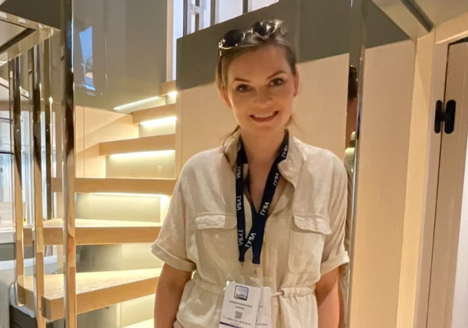
It is called luxury hospitality architecture. And the person who has been practising it, and defining it, longer than almost anyone is Tamara Maria Madra.

Read the full interview with Tamara Maria Madra, Founder and Strategic Director of D-Crew Academy, to discover how luxury hospitality architecture is redefining excellence at sea.
You have been working as a luxury hospitality architect for a long time — but it is not a title most people in the yacht industry recognise.
How did your career begin, and what was the path that led you to yachts specifically?
My path was never linear, which I now believe is exactly why it led me here. I began my professional life on land — in marketing, business coaching, and the creative world of art
galleries and music festivals in Poland and Belgium. I had degrees in Real Estate Management, Logistics Engineering, and a postgraduate in Diplomacy. When I first encountered the yachting world, I was genuinely hesitant. Life at sea seemed remote from everything I had built. But the moment I stepped aboard my first vessel, something shifted. What I saw immediately was not a service environment. It was an operational system — a complex, living organism where spatial design, human behaviour, and logistical precision were completely inseparable. Nobody was naming it that way. The industry called it interior management or chief stewardess work. But I saw it through the lens of everything I had studied: the building logic from real estate, the flow analysis from logistics, the communication systems from my coaching background. I started on 40-metre vessels and spent over a decade refining my understanding at every scale.Each new build, each refit, each global operation expanded my frame. By the time I was managing the interior build of a 114-metre vessel, I had stopped thinking of myself as someone who manages service. I had become someone who architects the conditions under which worldclass service becomes inevitable. The transition ashore, and the founding of D-Crew Academy,was simply the moment I gave that practice a proper name.
In your own words — what is a luxury hospitality architect, and how is it different from a naval architect or an interior designer?
A naval architect solves for physics. They deliver a vessel that floats, moves, and is safe. Their work ends, in the truest sense, the moment the vessel is certified.
An interior designer solves for beauty. They deliver an environment that is visually and
aesthetically coherent — and the finest of them create spaces that are genuinely extraordinary. Their work is what a guest sees in those first moments of arrival.
A luxury hospitality architect solves for the entire lifecycle of the experience. I work in the space that exists between the blueprint and the lived reality. I look at the same plans a naval architect produces and ask entirely different questions. Not ‘will this staircase bear the structural load?’ but ‘can a stewardess carry a tray up this staircase during a swell without the guest on the deck above hearing a single footstep?’ Where an interior designer selects a rare marble for a dining table because it is breathtaking, I am simultaneously calculating whether that marble can be maintained on the open ocean, what happens to it in a humid climate, and what specialist chemistry is needed to protect it when the nearest qualified stonemason is two thousand nautical miles away.
“A shipyard delivers a vessel. An interior designer delivers a vision. A luxury hospitality architect delivers the soul of the operation.”
It is a discipline that requires you to have genuinely inhabited all three worlds — the technical, the aesthetic, and the operational — and to think in all three simultaneously. That is what makes it rare. And, frankly, that is why the gap it fills has gone unnamed for so long. When a problem sits between three disciplines, none of the three disciplines owns it.
Everyone in the yacht business knows the rule: crew must be invisible, but service must be impeccable. Why is that paradox so difficult to
solve through conventional yacht design alone?
Because conventional yacht design optimises for what is seen, not for what makes the unseen possible. A shipyard produces a General Arrangement that shows every cabin, every salon, every deck. What it rarely shows with adequate precision is the pantry-to-service-point transit time, the acoustic separation between crew corridors and guest areas, or the provisioning flow from tender to refrigeration. The paradox is genuinely architectural. On a 100-metre-plus vessel, a guest should feel as
though they are the only person on earth being attended to. The magic of 7-star service is that it appears effortless — almost ambient. But to create that feeling, a complex operation is happening constantly just beyond the guest’s sightline. Heavy laundry rotations. Culinary staging for twelve-course dinners. Provisioning runs. Uniform changes between service styles. Team briefings. All of it occurring within a vessel where the separation between crew and guest space can, at its narrowest, be a single bulkhead.
Conventional design addresses this with a standard crew corridor. But a corridor is not a system. What I audit in any General Arrangement is whether that corridor actually allows the full choreography of a working service team to happen invisibly. Is the pantry positioned so that a stewardess walking from preparation to the dining salon crosses zero guest-visible space? Is the service lift positioned to eliminate the acoustic leak that a wheeled trolley creates on a marble floor? Is the crew mess located so that a 2am anchor watch change doesn’t travel through the zone above the owner’s stateroom? On most vessels without a hospitality architect in the design phase, the honest answer is no.
Not because the builders are careless — they are not. But because nobody asked those questions at the moment when it was still possible to answer them in steel and glass rather than in operational workarounds and exhausted crew.
A 100-metre yacht can represent a €200 million investment. How do you make the financial case for hospitality architecture to a shipyard
or an owner’s representative who sees it as a soft cost?
I understand why it looks like a soft cost. It has no line item in a Lloyd’s survey. It doesn’t appear in the build specification next to the propulsion system or the HVAC engineering. So I understand the instinct to place it in the same category as a nice-to-have. But consider what the cost of ignoring it actually is. A galley positioned one deck below the
primary entertaining space, with no direct service lift, means every course of every dinner requires a crew member to pass through a guest-visible zone. Multiply that across a full charter season and you have a structural service failure built permanently into a vessel that will never reach its charter rate potential. Not because the crew are underperforming, but because the architecture is working against them. Or consider the OS&E procurement. On a new build, the operating supplies and equipment — the crystal, the linen, the silver, the specialist cleaning chemistry — represent a significant budget. Without operational expertise at the table during procurement, that budget is frequently spent on items that are visually correct but operationally wrong: crystal that cannot survive the storage environment of a crossing, linen with no proper stowage solution, surface treatments that have no viable at-sea maintenance protocol. The replacement and modification costs in the first two years of operation routinely dwarf what a hospitality architecture consultation would have cost in the design phase.
“You are not paying for hospitality architecture. You are paying for the operational return on a €200 million asset. The two things are inseparable.”
The vessels I have worked on — 110m, 114m, 134m — are not just private assets. They are legacy statements. When the operation matches the engineering and the aesthetic, that vessel becomes a reference point in the industry. When it doesn’t, no amount of extraordinary design compensates for the owner’s private knowledge that something never quite worked the way it should.
When you are brought in by a yacht builder as a consultant, what do you actually look at? Where do most builders get it wrong?
The first thing I request is the General Arrangement, the interior designer’s specification, and the OS&E procurement brief. Then I look at all three together, because the errors are almost never in any single document. They are in the gaps between them.
I conduct what I call an Architectural Flow Analysis — a systematic audit of every route a crew member will travel during the most demanding service scenario on the vessel. I am measuring pantry-to-deck transit times, identifying where service lift positioning creates bottlenecks, and marking the acoustic risk points where crew movement will bleed into guest space. The most common error — and I find it on vessels built by shipyards of the highest reputation — is the placement of the main galley relative to the primary entertaining areas. A galley one deck below the main salon with no direct service lift means every course of every dinner requires crew to pass through a guest-visible staircase. The second most common is what I call beauty without durability: extraordinary materials chosen for their visual impact with no viable at-sea maintenance strategy. The third is the absence of a Day-One SOP Manual. Most vessels are handed over with exceptional engineering documentation and almost no operational documentation. The crew who will operate the vessel has no standardised framework for how to use the space they have been given.
I build that manual during the construction phase, not after handover, because the spatial logic of the vessel should shape the operational logic from the very beginning — not as an
afterthought.
Can you tell us about a moment when everything was on the line — a deadline, a client, a season — and the operation nearly broke? What
did you do, and what did it teach you?
There is a project I think about often. A vessel came to me after three years of being completely non-operational. She had been built to an exceptional standard — stunning architecture, extraordinary materials — but she had been dark for years and the operational infrastructure had never been systematically designed. The brief I was given was essentially: take her from zero to fully operational, with a major boat show, an owner trip, and a full charter season starting immediately after. No downtime. No margin for error.
What made it genuinely precarious was not any single problem. It was the density of simultaneous problems. I was rebuilding the interior operational logic from the ground up while simultaneously managing a refit across multiple Caribbean islands, recruiting and training a new interior team, overseeing every contractor relationship, and managing the vessel’s accounts, procurement, and provisioning. At one point I was also running as Chief Stewardess because that position was vacant and the owner trip could not be delayed.
What held everything together was not heroics. It was the systems I had built before the pressure arrived. Every decision I made in the first weeks of that project was oriented toward creating structure that would function without me at its centre. Rotas that were self-sustaining. Provisioning protocols that any team member could execute. SOPs that were written for the specific layout of that vessel, not generic best practice. When the pressure intensified — and it did — the team had something to hold onto that wasn’t my constant presence.
“The moment that tests an operation is never the one you planned for. The work is building something robust enough that the unplanned moment doesn’t break it.”
What it taught me is that resilience in a luxury operation is not a personality trait. It is an architectural one. It is built in advance, into the systems, the spatial logic, the training, and the culture. By the time the owner stepped aboard for that first trip, what they experienced was effortless. They had no idea what the preceding weeks had looked like. That is the point.
What does the guest feel when hospitality architecture has been done right? And what do they feel, even subconsciously, when it has been ignored?
When it has been done right, a guest feels a quality that is difficult to articulate but immediately recognisable. I would describe it as effortless abundance. Every need is met before it has been expressed. The environment feels responsive — as though the space itself is oriented entirely around their comfort. There is no friction, no waiting, no moment where a request creates a visible ripple in the operation.
This is not achieved by hiring exceptional people alone, though exceptional people are essential. It is achieved by giving those people a space that allows them to work invisibly and precisely. When the architecture supports the operation, the crew’s talent multiplies. When it works against them, even the finest team in the world cannot fully close the gap.
When hospitality architecture has been ignored, the guest rarely identifies the cause, but they will always feel the symptom. A dish that arrives fifteen seconds late. A door that opens at a moment that feels slightly wrong. A sound from somewhere they cannot locate that interrupts a conversation. A small delay that forces them to notice, just for a moment, that there are other people on this vessel and those people are working. These are not service failures. They are architectural failures — moments where the spatial
logic of the vessel has forced the operation into the visible. At the ultra-high-net-worth level, guests have experienced the best hotels, the best private estates, the best restaurants in the world. They do not need to articulate what is wrong. They simply feel that the experience is not quite equal to the investment. And that feeling, however subtle, is the real cost of hospitality architecture that was never done.
Can you give an example — without naming names — of a yacht that was transformed by applying luxury hospitality architecture principles? What changed, and what did the owner actually experience?
The vessel I described earlier — the one that came to me after three years dark — is the most complete example I can offer. What changed is almost impossible to point to physically, because the transformation was operational rather than architectural in the conventional sense. The surfaces were the same. The salon was the same. The guest cabins were the same. What was entirely new was the invisible logic that determined how those spaces functioned. Every storage system was redesigned for the specific operational demands of the vessel’s program. The provisioning flow was physically reorganised. The crew hierarchy was restructured to match the spatial reality of the interior layout. New SOPs were written that were not generic — they were written for this exact vessel, with its specific pantry positions, its particular service flow, its unique acoustic characteristics.
What the owner experienced on that first trip was seamlessness. Meals that arrived with a timing that felt natural rather than managed. Movement around the vessel that felt unobstructed and private. A team that was clearly well-led but never visible as a team — just as a series of perfectly placed moments of attention. He did not comment on the systems. He commented on how relaxed he felt. Which is precisely the intended outcome. When hospitality architecture works, the guest never knows it exists. They only feel its absence when it hasn’t been done.
“The guest should never be able to name what changed. They should only feel that something, at last, is perfect.”
You now apply these principles to private estates and land-based luxury properties, not just yachts. What does the maritime world understand about luxury operations that the land-based world simply hasn’t learned yet?
The maritime world operates under a constraint that land-based luxury has never faced: complete self-reliance. When something goes wrong on a 100-metre vessel in the middle of the Mediterranean, there is no call to a local specialist, no same-day delivery of a replacement part, no external team who can be on-site within the hour. The operation must contain its own solution. That constraint forces a level of systemic rigour that land-based luxury simply has never needed to develop.
What I bring from that world to a private estate or a luxury residence is, first, an obsessive audit of operational flow. Most high-end properties are designed by architects who have never considered what happens between the kitchen and the dining table at the level of precision that a giga-yacht demands. The result is estates where the domestic staff are working around spatial inefficiencies that the owner never sees but always feels — in the slight delay, in the momentary friction, in the service that is very good but never quite transcendent. Second, I bring materials intelligence. On a vessel, you learn very quickly that beauty and durability are not in tension — but only if you design for both from the beginning. The same principle applies to a private residence. Surfaces, textiles, and finishes that are chosen purely for their aesthetic impact, without a maintenance and preservation strategy, begin to show their cost within the first two years of occupation. On a yacht I learned to solve this problem with no external support. On land, the same thinking produces estates that retain their standard for decades rather than degrading quietly over time. Third — and I think this is the most significant transfer — I bring the understanding that staff management in a luxury environment is not HR in the conventional sense. It is human infrastructure engineering. The team who operate a private estate are not employees in a corporate structure. They are the living mechanism through which a physical environment becomes an experience. Getting the right people, placing them in the right roles relative to the specific spatial logic of the property, and building the systems that allow them to perform without friction — that is the work. And it is work the maritime world has been doing, at extraordinary levels of precision, for decades.
Where is this discipline heading next? What will luxury hospitality architecture look like on the superyachts of the future?
The discipline is moving in two directions simultaneously, and I believe both are essential. The first is toward earlier integration. The conversation around operational architecture is finally beginning at the conceptual design stage rather than during a post-handover correction. Forward-thinking shipyards and owners’ representatives are starting to understand that bringing an operational specialist into the room when the General Arrangement is being drawn is not an additional cost. It is the elimination of an enormous deferred cost. The time to close the gap between a vessel’s engineering standard and its operational standard is before the keel is laid. The second direction is toward intelligent personalisation. The giga-yachts of the next decade will incorporate AI-assisted environmental systems, predictive provisioning, and preference mapping technologies that allow a vessel to respond to an owner’s patterns in real time. But technology does not replace hospitality architecture. It amplifies it. An AI system that knows a guest prefers a particular cabin temperature is worthless if the HVAC creates a sound that penetrates the stateroom. A predictive provisioning system is useless if the galley-to-pantry flow creates a bottleneck precisely at the moment the system’s recommendations need to be executed. Technology reveals the quality of the underlying architecture. It does not compensate for its absence.
The luxury hospitality architect of the future will need to be fluent in data systems and smart building technology — not because the role becomes technical in a naval sense, but because the operational infrastructure of a 150-metre vessel will increasingly be a digital as well as a physical architecture.
“What will not change is the fundamental principle: a guest who feels, without being able to explain why, that this is the most perfect place on earth.”
Everything else — the spatial design, the material science, the operational systems, the human infrastructure — is in service of that single feeling. At D-Crew Academy, that is what I am building the next generation of professionals to understand. Service is not a performance. It is a designed outcome. And the designer of that outcome is the luxury hospitality architect.


